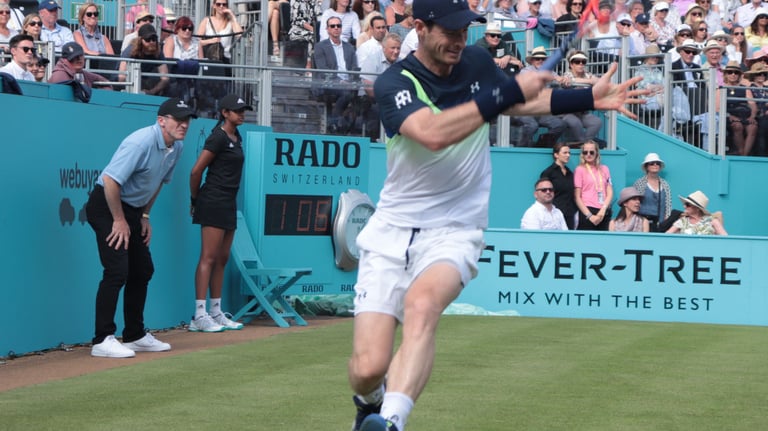
Nick Kyrgios, the Bad Boy of Tennis
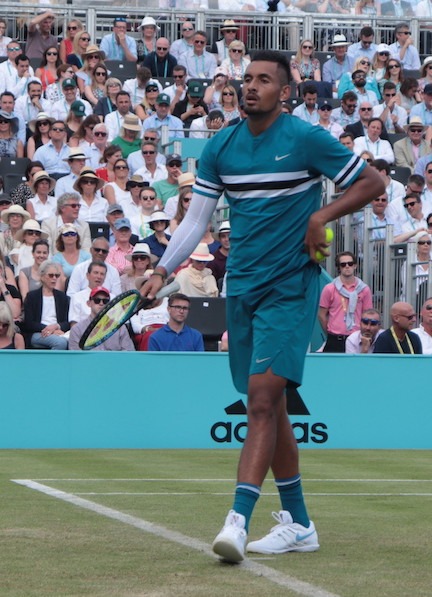
Photo: Katrina Allen
Rafael Nadal pulled out of the semi-final of Wimbledon, citing a 7mm abdominal tear. It was clear during his match against Taylor Fritz that something was up, and most of us, seeing him doubled up in pain, half expected him to retire. Nadal dug in, as he always does, and managed to eke out the win in a fifth set tie break. Should he have quit during the match, knowing he wouldn’t be fit enough to play the next round and deprive both his opponent and ticket holders of a semi-final? It’s a fair question.
Which meant that Nick Kyrgios, Rafa’s previously expected adversary in the semis, was now in the final of Wimbledon, not something anyone would have foreseen at the start of the tournament.
That year’s event was all about Kyrgios, really, partly for his brilliant tennis, but more for his extreme behaviour and subsequent fines. In his first round against the British player, Paul Jubb, apart from the constant chatter, he spat at a spectator and ranted at the umpire at virtually every changeover.
In the third round he beat Stefanos Tsitsipas, the fourth seed, in a spectacular match, more noteworthy for the players’ behaviour than for their game. These two really don’t like one another. As usual, Kyrgios chuntered the whole way through the match and wound up his opponent to the extent that the Greek walloped a ball, just missing a couple of spectators, followed by a belter at the scoreboard in response to a trademark Kyrgios underarm serve which was surely designed to get into his head.
The Wimbledon player and fellow Aussie Mark Woodford says of Kyrgios: “Some gamesmanship is OK, but I think he’s taken it too far. ”
OK, Kyrgios has been pretty abusive towards umpires but no more so than John McEnroe or Serena Williams.
And in terms of gamesmanship, well: what is that exactly and what’s “too far”? It’s a fine line and pretty subjective.
It’s easy to wind up an opponent – a smirk when they’ve just double-faulted or you’ve just made a lucky net cord, a long-distance glare, in the style of Ivan Lendl or Boris Becker after winning a long rally; or an underarm serve for which Kyrgios was originally vilified, except they’re all at it now and it’s a perfectly legal tactic and a sensible one if, like Nadal, your opponent is standing 15 foot behind the baseline.
Walloping the ball, Becker-style, at the opponent’s body? Again, perfectly legal, despite being so intimidating. Djokovic and Cilic bouncing the ball 17 times before serving? Nadal and his lengthy tics, Serena Williams doubling up and screaming after her opponent’s made an error, Becker coughing between his opponent’s first and second serves? “ Tanking” a service game to throw someone off as Kyrgios did in his fourth round match against Brandon Nakashima (and it worked)? Or screaming like Monica Seles just as she hit the ball so the opponent couldn’t hear the spin or pace off her racket. Was that deliberate? Who knows?
Players often take a medical time out at crucial points in the match. Are they really injured, or is it actually taken to disrupt their opponent’s concentration? These things are hard to prove.
Novak Djokovic made Cameron Norrie wait for a full five minutes before joining him to enter Centre Court in Cam’s first Grand Slam semi-final. Don’t tell me that wasn’t deliberate.
But tennis is as much about getting into your opponent’s head as simply playing better strokes — which is what makes the game so fascinating.
Of course there are rules, but there’s an umpire there to apply them. They can give a player warnings and dock points or even games for unacceptable behaviour. Players are also fined post-match in these cases, although amounts are paltry in relation to their prize money. I do think those fines should be much, much higher, to the point where it actually hurts the players ’ pockets.
But there is no doubt that there has been behaviour by Kyrgios which has been totally unacceptable. Telling Stan Wawrinka, mid-match: “My mate Kokkinakis has been banging your girlfriend”; throwing a chair onto the court in the Italian Open; swearing at a spectator; spitting towards lines-people.
Except the thing about the man is that, by turning his matches into a circus, he is hugely watchable. You don’t know what’s going to happen next and it’s definitely not dull. It’s as though he gets bored halfway through a match and decides to entertain the crowd. It can be pretty irritating for the opponent when, for instance, he serves underarm between the legs, just for a laugh.
Kim Clijsters says that when she coaches kids, 90 per cent tell her that Kyrgios is their favourite player. He puts bums on seats and stadiums are always packed when he is on court. He is box office and this is part of the dilemma for the tennis authorities.
Except that he seemed to have undergone a character transformation in his last two matches. No trick shots and few moaning attacks on umpires. He clearly now saw himself as a contender for the title and rather than clowning around, he appeared to be knuckling down.
Nick Kyrgios played his first Wimbledon and indeed grand slam final against Novak Djokovic on the Sunday. He did so under the cloud of an accusation of physical abuse by a former girlfriend resulting in an upcoming court case in Canberra. Now that’s real stress.
Would we get the “bad boy” or the apparently reformed player who says he thought his ship had sailed? Despite his behaviour, he — and not Djokovic, the defending Champion and tennis legend — was the crowd’s favourite. In the event, the Serb dismantled his opponent in four sets. Personally, I would have been pleased had the Aussie won the match although that might not have been the general feeling.